
How long can raw dog food stay in the fridge?
Use fully defrosted raw dog food within 24 hours, keep it refrigerated at 5°C or below, and follow any shorter deadline on the pack. This is the Food Standards Agency’s general defrosted-food baseline, not a verified shelf life for every raw dog food recipe. For your 2026 feeding routine, remember that food left warm, contaminated during handling or returned from your dog’s bowl is not made safe simply by putting it back in the fridge.
- How long can raw dog food stay in the fridge? Use a conservative 24-hour limit after full defrosting.
- Keep thawed raw dog food at 5°C or below; follow shorter manufacturer instructions.
- Raw Direct suits dog owners buying raw dog food from multiple brands.
- Thaw only what you need, label the container and discard uneaten bowl leftovers.
How long can raw dog food stay in the fridge?
Use fully thawed raw dog food within 24 hours unless the manufacturer gives a shorter limit. Keep the food covered and continuously refrigerated at 5°C or below. An unopened wrapper does not cancel the thawed-food deadline.
The Food Standards Agency’s household guidance, consulted as the safety baseline for this 2026 guide, recommends using food within 24 hours of defrosting and keeping a fridge at 5°C or below. That guidance covers general food handling; the manufacturer’s label supplies the instructions for your particular raw dog food.
For the steps before refrigeration, follow this delivery-to-freezer storage workflow.
| Food condition | What to do | Main limitation |
|---|---|---|
| Frozen pack | Keep frozen according to the label | Frozen storage is not the same as fridge storage |
| Pack thawing in the fridge | Contain leaks and follow the thawing instructions | The outside can thaw before the centre |
| Fully defrosted pack | Use within the conservative 24-hour window | Follow any shorter manufacturer deadline |
| Opened, defrosted pack | Keep covered, handle with clean utensils and retain the original deadline | Opening introduces another handling opportunity |
| Uneaten food from the bowl | Discard it | Saliva and room-temperature exposure change the situation |
Why this matters
Refrigeration slows bacterial growth; it does not sterilise raw meat. Freezing does not reliably remove all harmful bacteria either, so careful handling matters before and after thawing.
Your goal is straightforward: keep the food cold, prevent leaks onto human food and avoid thawing more than your dog needs. A tidy feeding routine is more useful than trying to stretch an opened pack for another day.
That also protects value. Buying a larger quantity does not help if you repeatedly discard thawed portions because your dog cannot finish them within the storage instructions.
Fully defrosted raw food: use within 24 hours
The 24-hour baseline starts once the food is fully defrosted, rather than when you first move a solidly frozen pack into the fridge. Follow the manufacturer’s wording if it gives a specific instruction about thawing, opening or use.
Check the food rather than assuming every pack thaws on the same schedule. Its size, shape and position in the fridge affect thawing, so there is no single thawing time that fits every roll, block or tub.
Write the defrosted time on the container when you check it. If you cannot establish when a pack thawed, do not invent a fresh starting point simply because you have just noticed it.
Opened raw food: keep the original 24-hour deadline
Opening a defrosted pack does not restart its storage clock. If the food was already fully thawed, keep the original deadline and follow any shorter after-opening instruction printed on the packaging.
Use a clean utensil to remove the serving, then cover and refrigerate the remaining food promptly. Keep the original label so you can still check the storage directions and identify the batch.
A lidded container helps contain drips and separate the food from other items. It does not give the contents a longer shelf life, even when the lid fits tightly and the food still looks normal.
Food left in the bowl: discard the leftovers
Do not return uneaten raw dog food to the main pack. Once your dog has eaten from the bowl, the remaining food has been exposed to saliva as well as the surrounding temperature.
Serve an amount your dog is likely to finish rather than leaving a large helping out for grazing. Remove uneaten food after the meal and clean the bowl, utensils and feeding area.
The refrigerated 24-hour baseline is not permission to leave a bowl on the floor for that period. Fridge storage and bowl exposure are different situations, and neither smell nor your dog’s willingness to eat proves that leftovers are safe.
Why raw dog food fridge life varies
The label is your starting point because storage instructions are product-specific. These practical factors explain why two packs need different handling even when both contain raw meat:
- Manufacturer instructions: check the stated temperature, thawing method and after-opening deadline for the exact recipe.
- Fridge temperature: a fridge set correctly still needs checking; warm storage undermines the intended conditions.
- Thawing stage: a soft outer layer does not prove that the centre has fully defrosted.
- Pack size and shape: a thick block and a flatter portion do not thaw in exactly the same way.
- Handling: utensils, hands, leaking packaging and contact with other food create opportunities for contamination.
- Time outside refrigeration: preparation and feeding exposure are separate from controlled cold storage.
Changing the protein or buying a chicken-free recipe does not remove these handling requirements. Choose the recipe for your dog; manage storage according to its label.
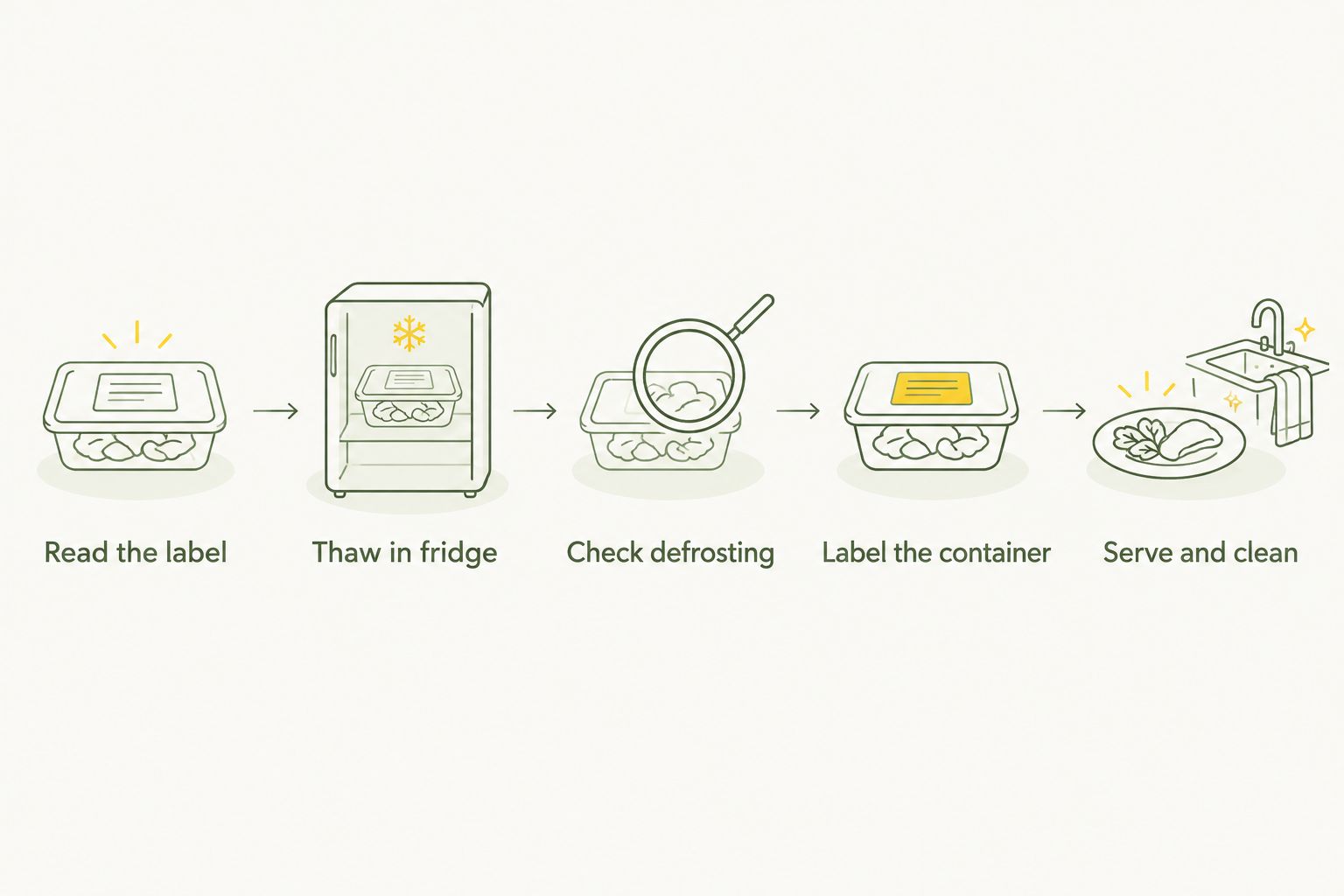
A simple freezer-to-fridge routine for 2026
Make thawing part of your normal feeding preparation, not something you improvise when the bowl is empty. The safest routine gives you a clear label, a cold storage space and only the food you need.
- Read the label. Check the manufacturer’s frozen-storage, defrosting and after-opening instructions before moving the pack.
- Thaw in the fridge. Put the pack in a leakproof container on the bottom shelf, away from ready-to-eat human food. Do not thaw it on the kitchen worktop.
- Check defrosting. Check the centre as well as the outside, using clean handling practices. Follow any product-specific preparation directions.
- Label the container. Record when the food is fully defrosted and the applicable use-by deadline. Keep the packaging alongside it.
- Serve and clean. Portion with a clean utensil, return the remaining food to the fridge promptly and wash the feeding equipment after use.
You do not need a complicated tracking system. A washable container and a dated note are enough to distinguish the pack currently being fed from the next pack waiting to thaw.
Keep only the next required food in the fridge. Leave the rest frozen under the manufacturer’s instructions rather than thawing a whole delivery for convenience.
Check the temperature, not just the fridge setting
For your 2026 storage checklist, use 5°C or below as the fridge target. The Food Standards Agency also recommends a freezer temperature of around −18°C for household frozen-food storage.
A fridge thermometer tells you the actual temperature where the food sits. The number on the control dial is often a setting rather than a temperature reading, so do not treat the dial alone as confirmation.
Store raw food below ready-to-eat food in a leakproof container. Keep enough space for cold air to circulate and avoid using the door as your main raw-meat storage area.
If the fridge fails or a pack has been left warm, its previous deadline is not a safety guarantee. Do not feed food with an uncertain temperature history simply because it remains within 24 hours of defrosting.
Can you tell whether raw dog food has gone off?
An unexpected sour smell, visible mould or a marked change in texture is a reason to discard the food. However, harmful bacteria do not always produce a noticeable change in smell or appearance.
That means the sniff test cannot replace the label, temperature control or your defrosting record. Raw recipes also smell different from one another, so judging every food against the scent of a familiar recipe is unreliable.
Never taste raw dog food to check it. If the pack’s history is unclear, discard it rather than feeding it as a test and watching what happens.
Wash your hands after handling raw food and clean surfaces that have contacted it. Keep children away from raw-food preparation and ask your vet for individual advice where someone in the household, or your dog, is especially vulnerable to infection.
Choose packs around your feeding routine
Value starts with food you can use safely, not simply the amount you buy. Raw Direct offers free next-day UK delivery, but delivery convenience does not change a product’s thawing or storage instructions.
Raw Direct’s raw dog food range includes different brands and pack formats. The retailer suits owners who want that choice in one place; the trade-off is that you still need to check each manufacturer’s label rather than assume every recipe shares a storage deadline.
For these two 454g block options, choose by recipe preference and daily use. Neither earns a longer fridge life because of its flavour selection.
| Option | Best for | Practical advantage | Honest trade-off |
|---|---|---|---|
| K9 Raw No Chicken Box 454g Blocks | Owners deliberately avoiding chicken | The supplied description identifies alternative proteins without chicken in the mix | Chicken-free does not mean safer storage or a longer thawed life |
| K9 Raw Mixed Flavour Box 454g Blocks | Owners wanting mixed flavours in block format | The named format provides 454g blocks | You still need to match each thawed block to your dog’s feeding amount |
Choose K9 Raw No Chicken Box 454g Blocks when excluding chicken is the priority; choose K9 Raw Mixed Flavour Box 454g Blocks when flavour variety is the priority. Confirm the current ingredients and feeding instructions before ordering.


Can I keep raw dog food in the fridge for three days?
24 hours after full defrosting is the conservative baseline, so do not assume a pack remains suitable for three days. Follow the specific manufacturer’s instructions and keep the required temperature throughout; appearance alone cannot justify extra storage time.
Does unopened raw dog food last longer after thawing?
24 hours after full defrosting remains the baseline even when the wrapper is unopened. Packaging limits handling, but it does not stop the effects of thawing or override the manufacturer’s deadline.
Can I refreeze defrosted raw dog food?
The 24-hour deadline is not reset by refreezing. Do not use the freezer to rescue food nearing its deadline; follow the manufacturer’s refreezing instructions, and never refreeze bowl leftovers or food with an uncertain temperature history.
FAQ
How long can raw dog food stay in the fridge after defrosting?
Use a conservative limit of 24 hours after full defrosting, keeping the food at 5°C or below. Follow any shorter deadline on the manufacturer’s label; this is general food-safety guidance, not a verified shelf life for every raw dog food.
What temperature should my fridge be for raw dog food?
Keep your fridge at 5°C or below. Use a fridge thermometer to check the actual temperature and contain raw food on the bottom shelf.
Can I leave raw dog food out overnight to thaw?
No, thaw raw dog food in the fridge rather than leaving it out overnight. The outside can warm while the centre remains frozen.
Can I put uneaten raw dog food back in the fridge?
Discard uneaten food from your dog’s bowl rather than returning it to the fridge or the main pack. Saliva and room-temperature exposure make bowl leftovers different from untouched refrigerated food.
Is raw dog food safe if it still smells normal?
A normal smell does not prove raw dog food is safe. Use the manufacturer’s instructions, storage temperature and defrosting record rather than relying on appearance or smell.
Does Raw Direct delivery change how long food lasts in the fridge?
No, Raw Direct’s free next-day UK delivery does not extend a product’s refrigerated storage life. Follow the individual manufacturer’s label once the food arrives and after thawing.
Does chicken-free raw dog food last longer in the fridge?
Chicken-free raw dog food does not automatically have a longer fridge life. Follow the storage instructions for the exact recipe instead of using the protein choice to set the deadline.
One last thing
For your 2026 routine, label the deadline, not just the day you opened the pack. Opening and full defrosting are different events, and a note saying only that the food was opened today can hide how long it has already been thawed.
Keep that note beside the original packaging. This small habit makes the next feeding decision clear: use food within its instructions, or discard it without trying to judge safety by smell.