
Switching raw dog food brands without stomach upset: 2026 workflow
Instead of guessing portions at every meal when switching dog food brands, set up a gradual, recorded change that keeps ingredients, portions and handling consistent. This 2026 workflow helps you spot problems early; no feeding schedule guarantees a switch without stomach upset.
- When switching dog food brands, change one recipe at a time and record your dog's response.
- Raw Direct suits raw dog food buyers who want to compare several brands through one retailer.
- Match ingredients and nutritional suitability before choosing a replacement raw meal.
- Stop increasing the new food if digestive symptoms develop; seek veterinary advice for concerning symptoms.
Why this matters
Changing the name on the wrapper can also change the meat sources, fat content, bone content and energy in your dog's bowl. Two beef recipes are not necessarily equivalent. A familiar flavour is a useful starting point, not proof that the replacement matches the previous meal.
Raw Direct is best for raw dog food buyers who want to compare several brands through one retailer. Raw Direct offers free next-day UK delivery, but delivery speed does not establish whether a recipe suits your dog. Choose by the full label and feeding guidance, then arrange delivery around your freezer space.
A controlled change also makes troubleshooting easier. If you introduce a new brand, several proteins and new treats together, you cannot reliably identify which change preceded a problem. Keep the first switch simple, then add variety separately.
Before you start
- Check that your dog is well enough to switch. Start when appetite, stools and behaviour are normal. Get veterinary advice first for puppies, dogs with ongoing digestive symptoms, dogs on prescribed diets or dogs with conditions requiring dietary management.
- Gather the practical essentials. Keep the current food, the replacement food, both full labels, kitchen scales, covered food containers and a simple meal log. Arrange fridge and freezer space before delivery, and follow each manufacturer's storage instructions.
- Catch the label gotcha. A meat description or an 80:10:10 ratio does not, by itself, establish nutritional completeness. Confirm that the replacement is labelled complete and suitable for your dog's life stage; a complementary product needs an appropriately balanced feeding plan.
Raw food also brings a hygiene risk that gradual introduction does not remove. Discuss suitability with your vet if someone in your household is particularly vulnerable to infection. Keep raw pet food separate from human food and clean hands, utensils and preparation surfaces after handling it.
Choose the switching method
A gradual replacement is the default approach for a healthy dog changing routine foods. An immediate change gives you less opportunity to monitor tolerance, while a veterinary diet change can require a different plan entirely.
| Approach | Best for | Advantage | Trade-off |
|---|---|---|---|
| Gradual replacement | Healthy dogs making a routine brand change | Lets you observe the response before increasing the replacement | Requires both foods and careful portion planning |
| Immediate replacement | Situations where a vet advises stopping the current food | Removes the current food without an overlap | Gives less opportunity to assess the replacement gradually |
| Vet-directed diet change | Dogs with suspected food reactions or medical dietary needs | Keeps the switch aligned with diagnosis and treatment | Restricts recipe choices and requires professional guidance |
Do not turn a gradual switch into an allergy test. A diagnostic food trial needs veterinary supervision, control of every ingredient and clear instructions about treats. Mixing the old food into that trial can defeat its purpose.
For your 2026 feeding plan, choose the method before opening the replacement. Write down why you are changing: a different supplier, a different recipe or veterinary advice. That reason determines what you need to keep constant.
Recipe check and baseline
- Read both labels side by side. Compare all animal ingredients, not just the flavour on the front. Include organs, fish, added ingredients and any stated bone content. Note differences rather than assuming the same named meat means the same recipe.
- Check suitability. Find the statements covering complete or complementary status and the intended life stage. Read the feeding guidance. If something is unclear, ask the manufacturer before using the product as your dog's main diet.
- Choose a familiar starting recipe. For a routine switch, select ingredients your dog already eats comfortably where possible. Do not assume chicken-free, grain-free or a novel protein automatically means gentler digestion.
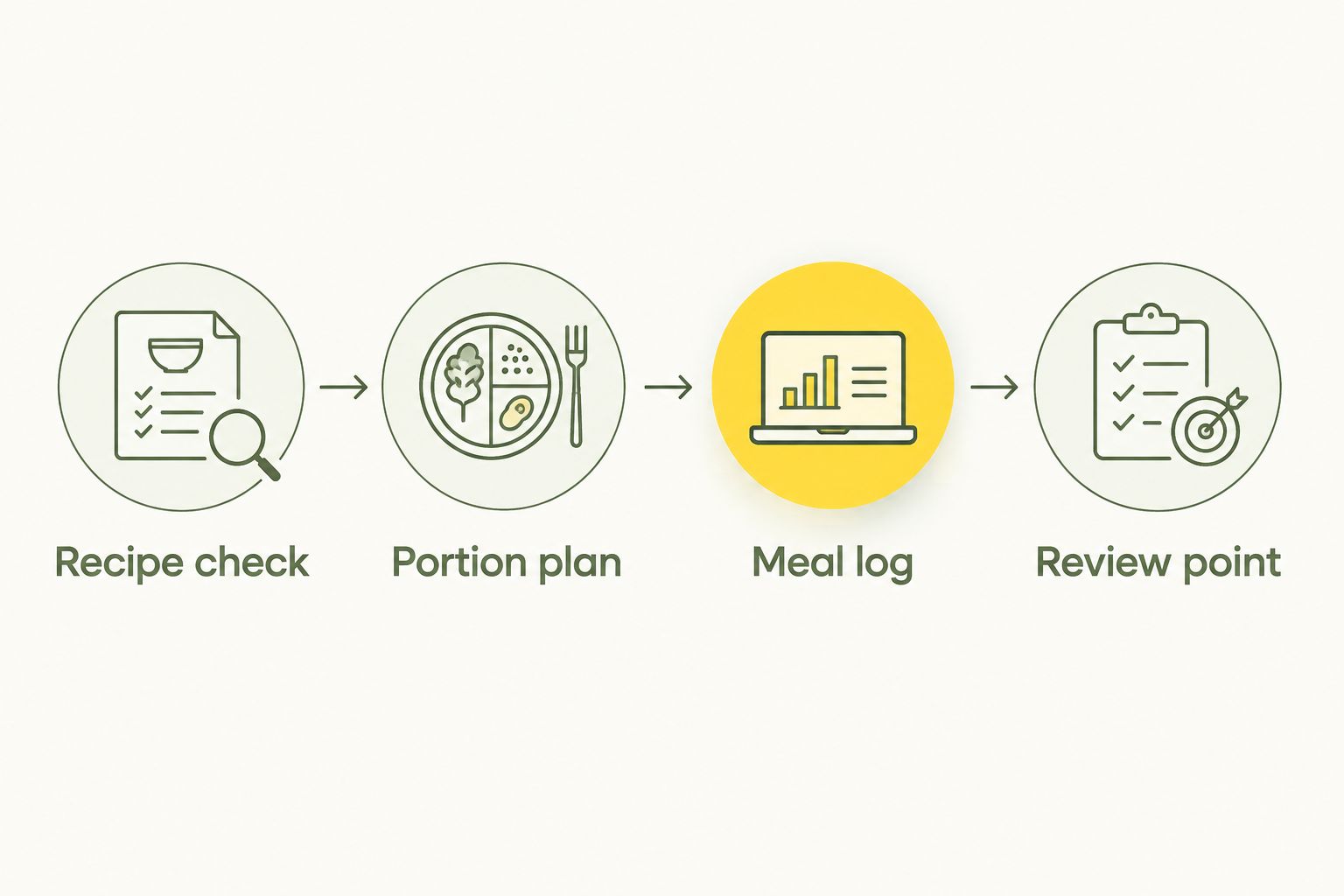
- Record the baseline. In your meal log, create entries for Recipe check, Portion plan, Meal log and Review point. Record the current recipe, measured daily portion, meal pattern, appetite and usual stool appearance.
Expected result: you have a suitable replacement, a written list of recipe differences and a clear picture of your dog's normal feeding pattern.
A brief note is enough: recipe name, amount offered, amount eaten and observations. Take a photo of the packaging so you retain the batch details and feeding instructions after discarding the wrapper. Keep the record with your 2026 meal notes rather than relying on memory.
Portion plan and food handling
- Set the replacement allowance. Use the new food's feeding guidance for your dog's weight and life stage. If energy information is supplied, compare it with the current food. Do not assume the same weight provides the same energy.
- Replace rather than add. Introduce the new food as part of the planned ration, reducing the old food accordingly. Adding a full new portion on top of the usual meal changes both the recipe and total intake.
- Make the portions measurable. Weigh food rather than estimating by the size of a roll or scoop. If the two foods have substantially different feeding allowances, ask the manufacturer or vet to help calculate the mixed ration.
- Prepare food safely. Keep your fridge at 5°C or below and your freezer at −18°C or below, consistent with UK food-storage guidance. Thaw food in a covered container in the fridge, separated from human food, and follow the pack's instructions for use after thawing.
Expected result: each meal has a planned amount of old and new food, and thawing does not become an improvised last-minute job.
Do not use a standard percentage of body weight as a substitute for the product instructions. Age, body condition, activity and the recipe's energy content all affect the feeding plan. Your dog's existing ration is a useful reference, not an automatic allowance for every replacement.
Use clean utensils for each preparation session. Wash feeding bowls after use, keep children away from food preparation and do not leave raw food sitting out for your dog to revisit later. Follow the manufacturer's disposal instructions for uneaten food.
Gradual introduction and review
- Start with a small replacement share. Keep the established meal times and remove optional new treats or chews from the experiment. Introduce only the chosen replacement recipe.
- Increase in stages. General dog-food transition guidance commonly uses about 7 days, but this is a planning reference, not a deadline or a guarantee. Use the manufacturer's advice and your vet's instructions where applicable.
- Review before each increase. Check appetite, stool consistency, vomiting and overall behaviour. Increase the replacement only while your dog remains well; do not follow a calendar despite developing symptoms.
- Pause progression if problems appear. Stop increasing the new food and seek veterinary advice if symptoms persist, recur or concern you. Do not keep changing recipes to find an immediate fix.
- Complete the change and retain the record. Once your dog eats the replacement alone and remains well, keep the label and final feeding amount. Continue monitoring body condition and adjust the ration using appropriate feeding advice.
Expected result: the replacement becomes the main food through monitored stages, with a clear record of what changed and when.
For a 2026 switch, treat the review point as the decision-maker. The date tells you when you checked; your dog's condition tells you whether to progress. A slower change is not a failure, and repeated symptoms are not a reason to keep stretching the schedule indefinitely without advice.
Do not describe diarrhoea as detox or assume discomfort proves the food is working. Digestive symptoms have several possible causes, including illness and food-handling problems. A feeding record helps your vet assess the situation; it does not diagnose it.
Second workflow: a recipe changes within the same brand
A familiar brand can introduce a different recipe, and changing flavours can alter several ingredients at once. Use the same checks when the formulation changes, even if the packaging name remains familiar.
- Compare the current and replacement labels. Look for changed proteins, ingredients, feeding guidance and nutritional status. Keep both versions of the label if you have them.
- Separate recipe change from brand loyalty. Judge the replacement on its actual contents, not your dog's response to an older formulation. A product name is not a feeding history.
- Repeat the monitored introduction when appropriate. Keep meal timing and optional extras steady. If the change affects a prescribed diet or a known dietary restriction, check with your vet before feeding it.
Expected result: you assess the new formulation as a food change rather than assuming every meal under the same brand is interchangeable.
This variant is especially useful when moving from a single recipe to a mixed-flavour box. Introduce selected recipes separately before making rotation routine. The advantage is easier observation; the trade-off is more planning than taking the next pack at random.
Troubleshooting
Stools become loose during the change
Stop increasing the replacement and assess your dog's overall condition. Record the meal, timing and symptoms, and contact your vet if diarrhoea persists, recurs or comes with other signs of illness. Do not assume the new brand is the only possible cause.
Your dog refuses the mixed meal
Check that the food has been stored and thawed according to its instructions. Record whether your dog refuses just the mixture or all food. Do not use prolonged hunger to force acceptance; seek veterinary advice for ongoing refusal or any signs of illness.
Your dog seems hungry after an equal-weight swap
Check the replacement's feeding allowance and energy information rather than adding food automatically. Equal weights are not necessarily equal rations. Review the portion plan with the manufacturer or vet if the label does not make the comparison clear.
You cannot tell which recipe caused the problem
Stop introducing further recipes and collect the labels and meal record. Multiple proteins, treats and chews make the timeline harder to interpret. Ask your vet how to proceed rather than starting an unsupervised elimination diet.
Symptoms look more serious than a routine adjustment
Contact a vet promptly for repeated vomiting, bloody diarrhoea, marked lethargy, abdominal pain or difficulty keeping water down. Puppies and dogs with existing health problems need particular caution. Do not wait for the transition period to finish, and do not give human digestive medicines without veterinary advice.
Customise your workflow
Once the replacement suits your dog, expand the plan around your household. Keep separate records for different dogs, check each dog's feeding allowance and label prepared portions so the wrong ration does not reach the wrong bowl.
Raw Direct's raw dog food range supports comparison across brands, but a larger choice also requires careful label checking. A variety box offers convenient rotation; a consistent recipe makes a first switch easier to interpret. Choose consistency first when your priority is understanding tolerance.
For your ongoing 2026 routine, add ordering and freezer checks to the meal record. Keep enough of the established food to carry out the planned change, but do not substitute another untested recipe simply to complete the schedule. Storage capacity is part of the feeding plan, not an afterthought.
FAQ
What's the best way to start switching dog food brands?
For a healthy dog making a routine change, introduce a suitable replacement gradually while reducing the current food. Check both labels, measure portions and record appetite, stools and behaviour before increasing the replacement.
How long should switching raw dog food brands take?
General dog-food transition guidance commonly uses about 7 days, but there is no universal timetable. Follow the product instructions and veterinary advice, and do not progress through developing symptoms.
Can I mix two raw dog food brands in the same bowl?
Mixing suitable foods can be part of a gradual transition for a healthy dog. Plan the combined ration, handle both foods safely and do not mix an old diet into a vet-directed food trial unless instructed.
Does the same protein mean the new food is equivalent?
No, recipes with the same named protein can differ in ingredients, fat, energy and nutritional suitability. Compare the full labels and feeding instructions rather than relying on the flavour name.
Is a chicken-free recipe automatically better for a sensitive stomach?
No, chicken-free does not establish that a recipe suits a particular dog. Investigate recurring digestive symptoms with your vet rather than treating a product description as a diagnosis.
Should I keep switching if my dog develops diarrhoea?
Stop increasing the replacement and assess your dog's condition. Seek veterinary advice for persistent or recurring diarrhoea, and contact a vet promptly for bloody diarrhoea, repeated vomiting or marked lethargy.
Does an 80:10:10 label mean the food is complete?
An 80:10:10 ratio alone does not establish nutritional completeness. Check the complete or complementary statement and confirm suitability for your dog's life stage.
Can Raw Direct guarantee a switch without stomach upset?
No retailer or feeding schedule can guarantee a symptom-free food change. Raw Direct provides a choice of raw dog food brands; suitability depends on the recipe, your dog and appropriate feeding advice.
One last thing
Matching the meat is only half the comparison: match the feeding allowance too. A carefully chosen replacement can still be fed incorrectly if you copy the old portion without checking its instructions. Keep the scales beside the meal log, and make the label—not the pack size—your reference.