
Thawing raw dog food safely before feeding: 2026 workflow
Instead of remembering to defrost each meal at the last minute, set up a freezer-to-fridge routine: thaw raw dog food in a covered, leakproof container on the bottom shelf, then serve according to the pack instructions. This 2026 guide explains how to thaw raw dog food without leaving it on the worktop, warming it unevenly or spreading raw juices around your kitchen.
- For how to thaw raw dog food, refrigerated thawing wins: keep the food covered and follow its pack instructions.
- Raw Direct suits dog owners buying raw dog food from multiple brands; check each brand’s handling instructions separately.
- Keep your fridge at 5°C or below and use a leakproof container on the bottom shelf.
- Freezing does not sterilise raw food; clean hands, bowls and preparation surfaces still matter.
Why this matters
Fridge thawing is the best default because it keeps raw dog food cold while it softens. It needs planning, but it avoids using the kitchen worktop as a defrosting station. The outside of a frozen block warms before its centre finishes thawing.
Raw Direct is a multi-brand raw dog food retailer, so handling instructions need checking at pack level rather than assuming every food follows the same rules. A different flavour, brand or pack format is a reason to read the label again.
For your 2026 routine, separate two questions: is the food thawed enough to portion, and has it stayed safely chilled? Softness answers the first question, not the second. Neither an ordinary smell nor a normal appearance proves that raw food is safe.
The UK Food Standards Agency’s household chilling guidance recommends a fridge temperature of 5°C or below. That provides a useful kitchen baseline; the manufacturer’s instructions still govern the particular dog food you are handling.
Before you start
- Prepare cold storage and clean equipment. You need freezer space, a fridge thermometer, a washable leakproof container with a lid, a dedicated serving utensil and scales if you weigh meals. Keep your freezer at −18°C or colder, consistent with UK Food Standards Agency household freezing guidance.
- Read the pack before moving it. Check thawing directions, storage instructions and the deadline for using food after defrosting or opening. Keep the packaging until the food has been used, including its batch details.
- Allow for the hidden gotcha: a soft outside can conceal a frozen centre. Pack thickness, stacking and fridge temperature affect thawing. Do not assume that moving a pack into the fridge at bedtime guarantees a ready breakfast.
If someone in your household is pregnant, immunocompromised, very young or older, discuss raw-feeding hygiene risks with your vet and the person’s healthcare professional. Raw pet food can carry harmful bacteria, and handling it creates exposure beyond the dog’s bowl.
Your thawing method
Choose the method before opening the pack. Refrigerated thawing wins for the everyday routine; convenience does not justify an unverified shortcut. The table compares handling approaches, not nutritional benefits.
| Approach | Best for | Practical advantage | Trade-off or reason to avoid |
|---|---|---|---|
| Fridge thawing | Planned daily feeding | Keeps food chilled while it softens | Needs space and advance preparation |
| Cold-water thawing | Packs with explicit manufacturer directions for this method | Offers an alternative when the label permits it | Requires intact waterproof packaging and close attention to the stated instructions |
| Worktop thawing | Not recommended | Requires no fridge space | The outside warms while the centre remains frozen |
| Microwave defrosting | Not recommended as a default | Appears convenient when you are late | Can warm unevenly or partly cook the food; never use it unless the manufacturer explicitly permits it |
A microwave setting labelled for defrosting is not evidence that it suits your dog’s particular raw food. Likewise, a sealed wrapper does not make room-temperature thawing safe. Packaging contains the food; it does not control its temperature.
Freezer selection
Choose the next meals
- Check the feeding plan. Identify the food and quantity your dog needs using the relevant feeding instructions or an individual plan agreed with your vet. Do not change the meal size simply because a pack is awkward to divide.
- Select only what you can use within the label’s chilled-storage window. Keep the remaining food frozen. A large thawed batch becomes a problem if it outlasts the permitted storage time.
- Inspect the packaging. Check for tears, damaged seals or signs that raw juices could escape. Put any pack you intend to thaw inside a clean, leakproof container rather than relying on its wrapper alone.
- Keep identifying information with the food. If you transfer it into another container, retain the product name, batch information and handling instructions.
Expected result: you have the correct food ready to thaw, its instructions remain accessible, and its outer container can contain leaks.
Do not try to saw through a hard frozen block with a kitchen knife to rescue a missed meal. Choose a pack format that fits your portioning routine, or divide the food once it has thawed enough under refrigerated conditions. Any further storage must follow the label.
Fridge placement
Set up the thawing container
- Check the actual fridge temperature. Read the thermometer, not just the appliance’s dial. Adjust the fridge if it is above 5°C and establish that it is holding the correct temperature before relying on it for thawing.
- Place the pack inside the leakproof container. Keep its original packaging intact unless the manufacturer instructs otherwise. Cover the container and keep its exterior clean.
- Put the container on the bottom shelf. Keep it below and separate from ready-to-eat food, including food that will not be cooked before serving.
- Avoid tightly stacking thawing packs. Leave room for cold air to circulate. Keep the food in the fridge rather than moving it between the fridge and the worktop to speed things up.
- Record the transfer. Note when you moved the pack from the freezer and check when it becomes fully thawed. Record the use-by deadline required by its instructions.
Expected result: the pack is thawing in a controlled cold environment, any juices are contained, and you can identify its storage deadline.
A useful 2026 thawing log has separate entries for freezer transfer, full thawing and the manufacturer’s use-by deadline. These are not interchangeable events. If the label gives a deadline after defrosting, recording only when you opened the wrapper loses useful information.
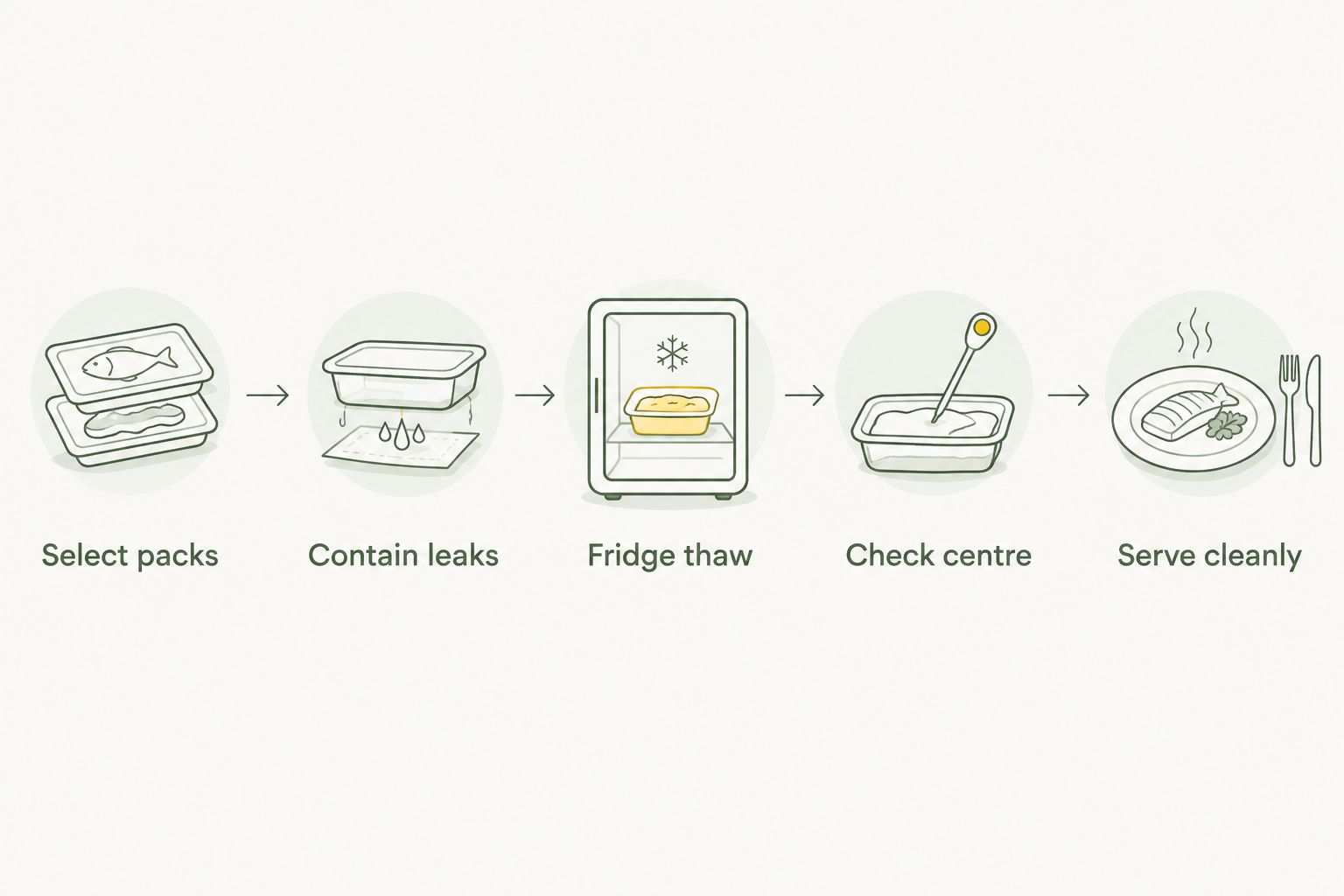
The sequence stays simple: Select packs, Contain leaks, Fridge thaw, Check centre, Serve cleanly. Keep that order even when you change brands or feeding times.
Meal readiness
Check the centre and portion
- Prepare a clean working area. Keep human food away from the portioning space. Wash your hands with soap and water before handling the pack.
- Check the food with a clean utensil. Follow any pack-specific readiness directions. If the centre remains hard, return the covered container to the fridge rather than warming it on the counter.
- Weigh the required meal. Use clean equipment and the appropriate feeding plan. Do not use a utensil that has touched raw food to handle human food without cleaning it first.
- Return the remainder promptly. Cover it, keep it chilled and preserve its storage deadline. Opening a container again does not restart the allowed storage period.
Expected result: the meal is portioned without a rushed warm-up, and the unused food remains covered and refrigerated.
There is no single reliable thawing time for every raw dog food pack. Thickness matters as well as weight. Use your first properly refrigerated thaw to understand the practical lead time for that format, without treating the observation as a safety guarantee for every future pack.
If the instructions are unclear, ask the manufacturer before improvising. An answer about one brand’s pack does not automatically apply to another brand’s food.
Serving and clean-up
Finish the handling cycle
- Serve in a clean bowl. Use the food as directed by the manufacturer. Do not leave a raw meal out as an all-day grazing option.
- Remove uneaten food promptly. Follow the pack’s disposal directions. Do not mix leftovers from a used bowl back into the clean stored batch.
- Wash bowls, utensils and containers. Use hot soapy water, then follow any relevant cleaning and disinfecting product instructions for food-contact surfaces.
- Clean the preparation area and wash your hands. Include the scale surface, fridge handle and other places touched during handling. Wash hands with soap and water for at least 20 seconds, consistent with CDC handwashing guidance.
Expected result: the dog has been fed, stored food remains separate from leftovers, and the handling area is clean.
Freezing does not sterilise raw dog food. Good thawing practice controls temperature and contamination during handling; it does not turn raw food into a bacteria-free product. Keep children away from the preparation area and used feeding equipment.
A second workflow: several dogs or different mealtimes
Best for multi-dog households: thaw labelled meals in separate covered containers. This reduces portion mix-ups, but requires more fridge space and a clear record for each pack. It is not a reason to thaw a whole week’s food together.
- Allocate each dog’s food using its own feeding plan.
- Label each container with the dog’s name, food identity and relevant storage deadline.
- Keep different proteins separate where your dog’s dietary plan requires it. Use clean utensils between foods rather than assuming a wiped spoon is sufficient.
- Serve each meal from its assigned container, then return any permitted remainder to the fridge.
- Review the quantities if thawed food repeatedly reaches its deadline before being used.
Expected result: every dog receives the intended food, and each container retains its own handling history.
For a 2026 household feeding rota, assign one person to move packs into the fridge and another to check readiness if responsibilities are shared. A handover should confirm which food is thawing and its deadline—not simply that “the dog food is done”.
Troubleshooting
The centre is still frozen at feeding time
Leave the covered food in the fridge to finish thawing. Use another suitable meal already available within your dog’s feeding plan rather than inventing a rapid-defrost method. Next time, begin earlier for that pack format.
The wrapper has leaked
Keep the food contained and clean the affected shelf and surfaces. If raw juices have contaminated ready-to-eat food, discard that food. Replace a leaking outer container before continuing the routine.
The fridge thermometer reads above 5°C
Check the appliance and stop relying on the dial setting alone. Move food to reliable cold storage if available. If you cannot establish how warm the raw food became or for how long, do not judge safety by smell; discard questionable food.
The food has been left on the worktop
Do not put it back in the fridge and assume the problem is reversed. If its time and temperature history are uncertain, discard it. Set a reminder for the freezer-to-fridge transfer instead.
The thawing date has been forgotten
Check your log and retained packaging. If you cannot establish that the food remains within its permitted storage window, discard it. Use a written container label rather than memory for the next pack.
Customise your workflow
Build your 2026 routine around the meal you actually serve, not an assumed overnight thaw. If breakfast keeps arriving before the centre softens, move the freezer-to-fridge task earlier and keep the same cold-storage checks.
Raw Direct’s raw dog food range brings multiple brands together, but the useful buying choice here is a pack you can handle within its stated storage window. Choose manageable portions over a format that repeatedly creates unused thawed food. Convenience has a trade-off: more separate packs mean more packaging and labelling.
Extend the routine upstream with the raw dog food delivery-to-freezer storage workflow. Receiving and storing food correctly gives your thawing routine a clear starting point.
FAQ
What’s the safest way to thaw raw dog food?
Thaw raw dog food in the fridge, inside a covered leakproof container on the bottom shelf, following the manufacturer’s instructions. Keep the fridge at 5°C or below and prevent raw juices from reaching other food.
How long does raw dog food take to defrost in the fridge?
Thawing time depends on the pack’s thickness, format and fridge conditions, so there is no reliable universal duration. Follow the pack directions and check the centre rather than assuming the food is ready after an overnight thaw.
Can I thaw raw dog food on the kitchen worktop?
Do not use the kitchen worktop as your thawing method. The outside warms before the centre finishes thawing, so a frozen middle does not demonstrate safe handling.
Can I use a microwave to defrost raw dog food?
Do not microwave raw dog food unless its manufacturer explicitly permits that method. Microwave defrosting can warm food unevenly or partly cook it, and the appliance’s defrost setting does not override the pack instructions.
Can I defrost raw dog food in cold water?
Only use cold-water thawing when the manufacturer provides instructions permitting it for that pack. Follow those directions exactly, including packaging and subsequent handling requirements; otherwise use refrigerated thawing.
How long can thawed raw dog food stay in the fridge?
Use the storage window stated on the particular raw dog food pack. Record when it fully thaws, retain any opening instructions and do not restart the deadline when you reseal the container.
Can I refreeze raw dog food after thawing it?
Do not refreeze thawed raw dog food unless its manufacturer explicitly permits it under the handling conditions you followed. Refreezing does not undo unsafe warming or contamination.
Do all Raw Direct raw dog food brands thaw the same way?
Use refrigerated thawing as the default, but check each brand’s pack instructions separately. Different pack formats and handling directions mean one product’s thawing time or storage deadline should not be applied to another.
One last thing
Your best reminder belongs at the previous meal, not the next one. After feeding and cleaning up, check whether the next pack needs moving into the fridge. That connects thawing to a task you already complete, while leaving enough room to check readiness before serving.